Iron Condor
The King of High-Probability Income
Sell premium on both sides of the market — collect cash when the stock stays inside your range. The #1 strategy for consistent monthly income in sideways or range-bound markets.
Iron Condor = Credit Spread Sandwich
Sell Put Spread
Bearish credit spread
Total credit received
Sell Call Spread
Bullish credit spread
Max loss known on day 1
Live Example: SPY Iron Condor (45 DTE)
SPY = $578 | IV Rank = 18 (low → cheap options)
Put Credit Spread (Bearish)
Sell $560 put → +$4.80
Buy $550 put → −$2.10
+$270 credit
Call Credit Spread (Bullish)
Sell $595 call → +$4.20
Buy $605 call → −$1.90
+$230 credit
Total Credit
Range: $560 – $595 (6% wide)
85–90 % probability of profit
+$500 Profit
All four options expire worthless
You keep 100 % of credit
Iron Condor Math: Breakeven, P/L, Probability
$555 & $600
Short strike ± credit received
+$500
Credit received
$4,500
Width of wider spread − credit
Key Formulas
Upper Breakeven = Short call strike + Credit
Iron Condor Golden Rules
Only enter when IV Rank < 30 (cheap options)
45–60 DTE = sweet spot
Wings 5–15 points wide (risk/reward balance)
Close at 50 % profit or 21 DTE
Never hold through earnings or FOMC
Use on SPX, NDX, or high-liquidity ETFs
Adjust or close if breached early
Quick Quiz – Iron Condor
1. An iron condor consists of how many legs?
2. You collect $5 credit on a $10 wide iron condor. Max profit and loss?
3. Best time to enter an iron condor?
4. True or False: Iron condors have undefined risk.
5. You should close an iron condor when:
Answers
- 4
- +$500 / −$1,000
- When IV Rank is low (< 30)
- False — risk is 100 % defined
- It hits 50 % profit
Iron Condor Adjustment Playbook
Pros don't just "hope" — they adjust. Here are the 5 most powerful fixes.

1Roll the Tested Side
Most common & powerful fix
- Stock breaches your short put or call?
- Buy back the entire tested spread
- Re-sell it 1–3 strikes further out (same expiration or next week)
- Often collect extra credit → lowers or eliminates original loss
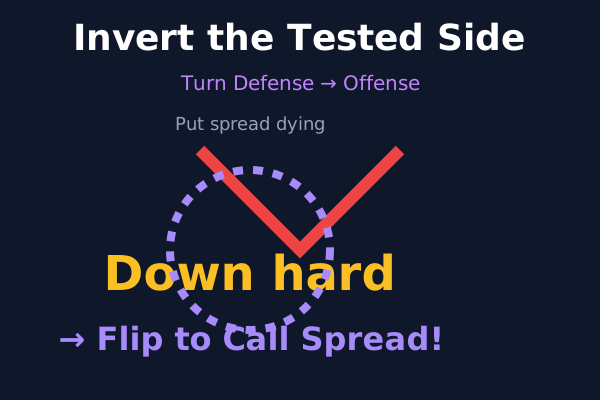
2Invert the Tested Side
Turn a loser into a winner
- Short put spread now deep ITM?
- Buy back short put + long put → close for loss
- Immediately sell a new call credit spread above current price
- Now you're rooting for the original move!
3Turn It Into a Broken-Wing Butterfly
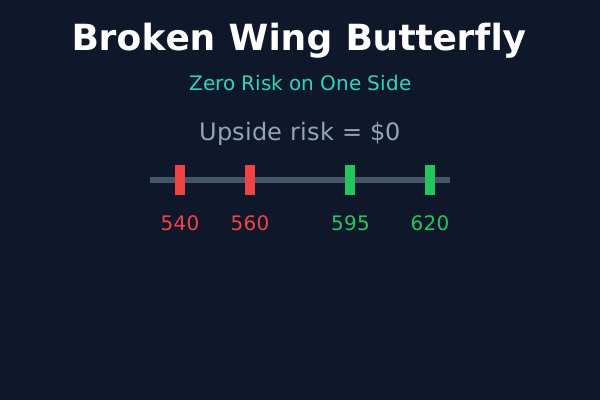
Eliminate one side's risk
- Tested side hurting? Widen the untested spread
- Move the long leg so far that max loss on that side = $0
- Now you can only lose on one side
4Lock Profit & Re-Center
When you're already up big
- Take 70–80 % profit early
- Re-open a new balanced iron condor centered on current price
- Collect fresh premium again

5Just Close It
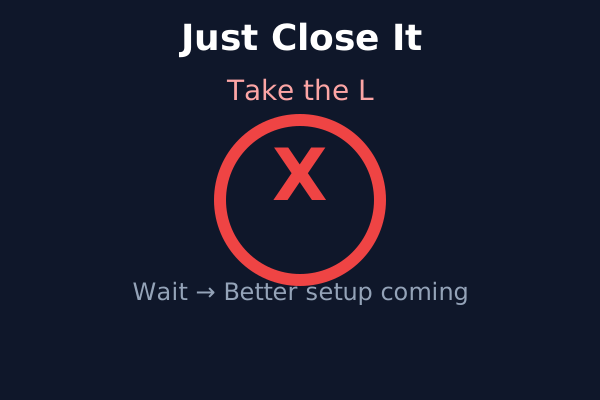
Sometimes the best adjustment is none
- Take a small loss
- Wait for IV to drop and market to stabilize
- Re-enter with better pricing
30-Second Decision Tree
Early breach?
→ Roll tested side
Big fast move?
→ Invert it
Already profitable?
→ Lock + re-center
Iron Condor FAQ
What is an iron condor?
An iron condor is a four-legged, market-neutral options strategy that profits when the stock stays within a range. It combines a bull put spread (below current price) and a bear call spread (above current price). You collect a net credit and profit if the stock stays between the short strikes.
When is the best time to trade iron condors?
Iron condors work best in high-IV environments with range-bound stocks. Ideal conditions include IV percentile above 50, low directional conviction, and no major catalysts expected during the trade. They benefit from time decay and volatility contraction.
What is the typical win rate for iron condors?
Well-structured iron condors (16-delta wings, 30-45 DTE) have approximately 60-70% probability of profit. However, when they lose, the losses are larger than the wins, so consistent position sizing and stop-losses are essential for long-term profitability.
How do I manage an iron condor that's being tested?
If the stock moves toward one of your short strikes, you can: close the entire position, roll the tested side further out, or close just the threatened spread. Most traders set a stop-loss at 1.5-2x the credit received.
How do I automate iron condor trading on Treeova?
Use the prompt-based strategy builder: 'Build an iron condor agent for SPY. Enter when IV percentile is above 50 and VIX is between 15-25. Use 16-delta wings, 30-45 DTE. Alert me at 25% profit target and 2x loss stop. Run analysis every market day at 10:00 AM.' The AI monitors all conditions.
Apply This on Treeova
Iron condors are a premium-selling strategy that profits in range-bound markets. Automate the setup on Treeova.
Check Market Conditions
Verify that IV percentile is elevated (>50) and the stock appears range-bound with no major catalysts ahead.
Structure the Trade
Select 16-delta wings with 30-45 DTE. Ensure the credit received provides adequate risk-reward for the defined-risk spread.
Deploy Monitoring Agent
Use the prompt-based strategy builder to automate entry signals and risk management alerts.
💡 Example Prompt
"Build an iron condor agent for SPY. Enter when IV percentile is above 50 and VIX is between 15-25. Use 16-delta wings, 30-45 DTE. Set auto-alerts for 25% profit target and 2x loss stop. Run analysis every market day at 10:00 AM."